
About the Book
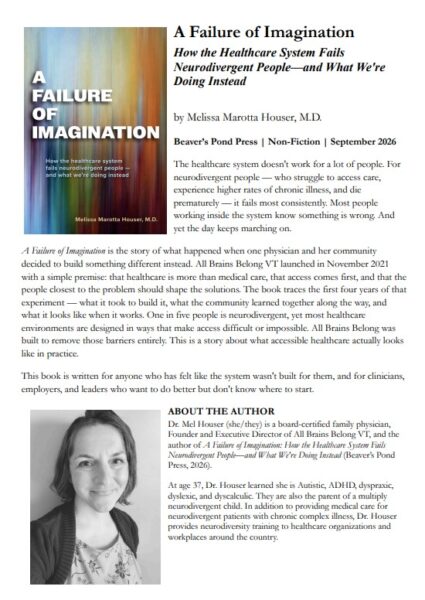
The healthcare system doesn’t work for a lot of people. For neurodivergent people — who struggle to access care, experience higher rates of chronic illness, and die prematurely — it fails most consistently. Most people working inside the system know something is wrong. And yet the day keeps marching on.
A Failure of Imagination is the story of what happened when one physician and her community decided to build something different instead. All Brains Belong VT launched in November 2021 with a simple premise: that healthcare is more than medical care, that access comes first, and that the people closest to the problem should shape the solutions. The book traces the first four years of that experiment — what it took to build it, what the community learned together along the way, and what it looks like when it works.
It’s written for anyone who has felt like the system wasn’t built for them, and for clinicians, employers, and leaders who want to do better but don’t know where to start.
About the Author
Dr. Mel Houser (she/they) is a board-certified family physician, Founder and Executive Director of All Brains Belong VT, and the author of A Failure of Imagination: How the Healthcare System Fails Neurodivergent People—and What We’re Doing Instead (Beaver Pond Press, 2026). A Failure of Imagination tells the story of All Brains Belong’s first four years, as proof of concept that a different kind of healthcare practice — and a different kind of community — is not only possible, but already exists.
At age 37, Dr. Houser learned she is Autistic, ADHD, dyspraxic, dyslexic, and dyscalculic. They are also the parent of a multiply neurodivergent child. In addition to providing medical care for neurodivergent patients with chronic complex illness, Dr. Houser provides neurodiversity training to healthcare organizations and workplaces around the country.
Story Hooks & Possible Angles for Coverage
- The healthcare access problem hiding in plain sight
- Reimagining the doctor-patient relationship
- A healthcare model co-created with patients
- Loneliness is a medical problem
- This already exists
- Built from the inside out
- How workplaces can reduce turnover
The healthcare access problem hiding in plain sight
One in five people is neurodivergent, yet most healthcare environments are designed in ways that make access difficult or impossible — long waits, fluorescent lights, rushed appointments, forms that assume everyone communicates the same way. All Brains Belong was built to remove those barriers entirely. This is a story about what accessible healthcare actually looks like in practice.
Reimagining the doctor-patient relationship
What if patients helped design their own care? At All Brains Belong, the people closest to the problem shape the solutions — and the results are measurable. In 2025, 93% of patients reported improved health. This is a story about what happens when medicine stops treating patients as passive recipients of care.
A healthcare model co-created with patients
All Brains Belong didn’t launch with a finished model and invite patients in. The community built it together. This is a story about what it means to take “nothing about us without us” seriously inside a medical practice.
Loneliness is a medical problem
Social isolation is one of the most significant drivers of poor health outcomes — and one of the least addressed in clinical settings. All Brains Belong treats connection as a clinical intervention, not a nice-to-have. This is a story about community as medicine.
This already exists
The conversation about healthcare reform is often theoretical. All Brains Belong is not a proposal. It’s been running for five years, in Vermont’s state capital of Montpelier, and it works. This is a story about proof of concept.
Built from the inside out
Most doctors quietly share an awareness that something is wrong — that the system doesn’t work for everybody. And yet, as one physician puts it, “This is just the way it is, so this is what we have to do. So we’re gonna keep doing it.” The decision to build All Brains Belong wasn’t the hopeful pursuit of a better world. It was, as Dr. Mel Houser describes it, “an urgent blend of terror, pain, desperation, and rage.” She had spent more than a decade inside the system — and so had her patients. They had all been failed by the same thing. This is a story about what gets built when the people closest to the problem stop waiting for the system to change.
How workplaces can reduce turnover
Most workplace environments were designed with a narrow range of needs in mind — and when employees can’t meet expectations, the system blames the employee. All Brains Belong trains organizations to ask a different question: what would it look like to design a workplace where everyone can do their best work? The strategies that support neurodivergent employees — clear communication, sensory-friendly environments, flexible structures — tend to make work better for everyone. This is a story about what happens to turnover, morale, and productivity when you stop trying to fix your employees and start looking at the environment instead.
Buy the Book (Pre-orders available now)
Print books: Direct sales available for U.S. shipping only. Folks outside the U.S. should choose Amazon.


Ebook: Click here to pre-order ebook for Kindle or click here to pre-order from other ebook platforms.
Audiobook: Available when the print book releases (11/6/2026)