
Creating better onboarding experiences for employers and employees
Starting a new job goes better when employers and employees know how each other works best. This tool helps employers and new hires proactively start that conversation. It is for everyone — not just people who have formally requested workplace adjustments.
This tool uses universal design. That means offering things in many different ways, so everyone can choose what works best for them. When everyone is offered the same options, no one has to single themselves out. People feel more comfortable talking about how they work best. This is a conversation tool, not a formal request process. Nothing here creates obligations for employers or employees.
Possible Ways to Use This Tool
As an employer or supervisor
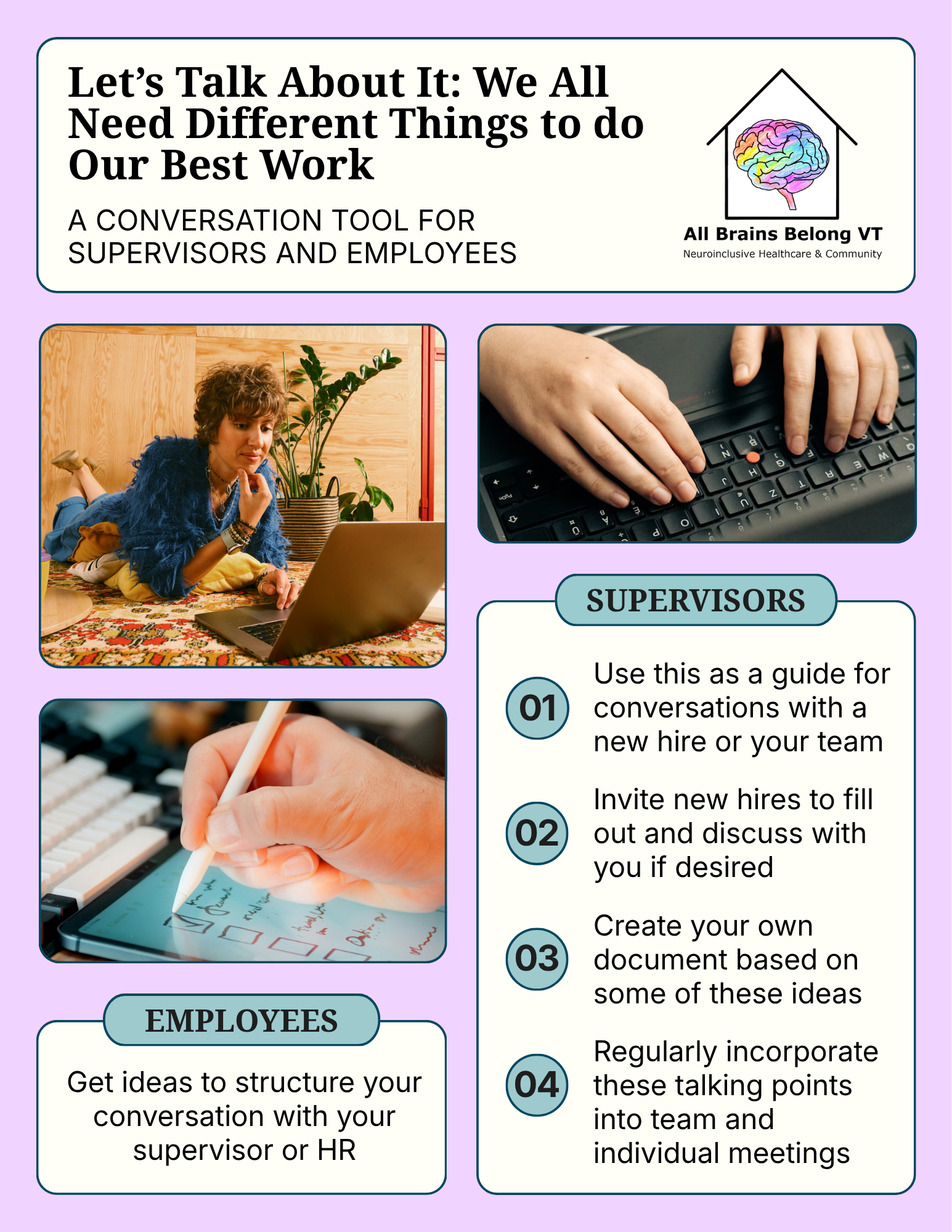
- Use this as a guide for yourself to have conversations with a new hire or your team
- Consider asking new hires to complete all or part of this (does not need to be all at once) — either to be discussed with you (or not)
- Create your own document based on some of these ideas
- Incorporate some of these talking points into team meetings and/or one-to-one check-ins over time
As an employee
Get ideas for conversations with your employer or your team.
Note: you may see a brief security check before the form loads to provide your email address. The toolkit will be sent by email.
More Resources from All Brains Belong VT
- Neuroinclusive Employment Training
- A Failure of Imagination: How the Healthcare System Fails Neurodivergent People—And What We’re Doing Instead
- Brain Club® – virtual community education about neuroinclusive culture
- Sign up for our monthly neuroinclusive employment tips newsletter
- Sign up for our twice monthly announcement list – more free resources
Acknowledgments
This “universal design” menu was co-created with more than 50 neurodivergent patients and members of the All Brains Belong community. We would also like to acknowledge the following community leaders for providing feedback to adapt our neuroinclusive employment approaches to more traditional employment settings: Jae Basiliere, Heather Batalion, Connie Beal, Lucia Boatman, Casey Ehrlich, Suzanne Eikenberry, Nicole Haley, Rachel Jolly, Meg Miller, Kathi Partlow, Emily Seifert, and Kari White.
Special thanks to the Organization for Autism Research (OAR) and the Health Resources and Services Administration (HRSA) of the U.S. Department of Health and Human Services (HHS) under the Autism Intervention Research Network on Physical Health (AIR‐P) grant for supporting parts of this project. Click here for additional information about this sponsorship. We are also deeply grateful for the generous contributions of our community members who have supported this project with their time, skills, and philanthropy.